
A headline can move a force posture.
When validation changes alliance confidence, domestic tolerance or perceived intent, the geometry of deterrence changes before any asset moves.
The Spectral Governance Model (SGM) reveals how coercion, resources, incentives, legitimacy, narrative and visibility combine—and fail to combine—across a causal terrain.
When validation changes alliance confidence, domestic tolerance or perceived intent, the geometry of deterrence changes before any asset moves.
A subjective signal can alter reporting, recruitment, silence, protection and local cooperation—converting Blue into Yellow access or Red constraint.
Official, proxy and covert modes change deniability, backlash, credibility and the future coalitions an intervention makes accessible.
Force may dominate physical terrain and still fail in legal or psychological terrain. Capital may buy capacity but not legitimacy. Narrative may shape perception but fail to produce logistics. SGM makes those asymmetries inspectable.
The minimal grammar remains Red, Yellow and Blue. Luminosity changes how each vector operates; it is not a fourth form of power.
Force, policing, sanctions, detention, blockade, access denial and other forms of hard control.
Capital, logistics, labor, infrastructure, supply, attention, incentives and dependency-producing resources.
Law, authority, narrative, trust, recognition, protocol, culture, identity and accepted interpretation.
Officiality, exposure, deniability, transparency and clandestinity alter surprise, backlash and targetability.
Dominance depends on access, timing, coherence, terrain fit and conversion. A system can hold a large stock of one spectrum while remaining unable to project it into the outcome that matters.
Force, capital, legitimacy, access or information.
Position, channels, institutions and permissions.
Capital into logistics; legitimacy into cooperation.
Range, latency, coordination and resistance.
Backlash, adaptation, cost and structural learning.
Evaluates the composition, balance, conversion, projection, perception and visibility of power across the relevant SGM spectra.
Question: Which power configuration dominates this field?Evaluates how the broader causal architecture makes behaviors and futures likely, persistent or governable—including feedback, incentives, constraints, leverage, timing, risk and learning.
Question: Which causal structure governs what can happen?SGM examines whether heterogeneous power can be combined, positioned, sequenced and sustained across military, economic, diplomatic, technological, logistical, informational and institutional terrain.
The public model exposes governing functions—not proprietary weights or an expanded private vector schema.
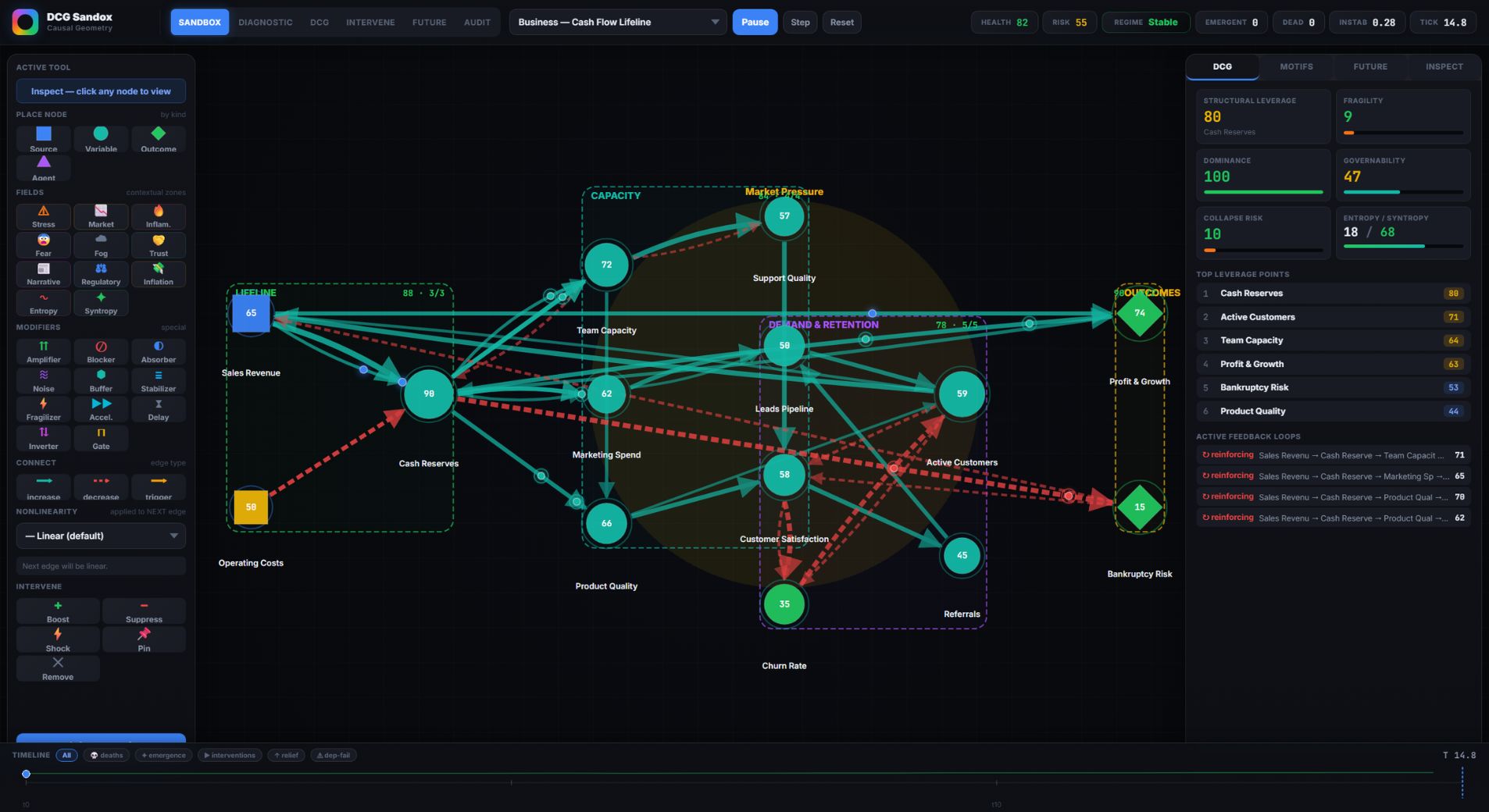
The Sandbox joins the spectral field to a living causal model. Analysts can inspect how Red coercion, Yellow metabolism and Blue validation connect to actors, constraints, feedback loops and leverage—and how a change in one channel reconfigures the others.
This is the difference between color-coding a situation and modelling power: every spectral assignment must connect to terrain, evidence, conversion and consequence.
Actors, terrains, asymmetries and dependencies.
Red, Yellow, Blue and Luminosity by context.
Where resources become action, compliance or legitimacy.
How validation changes across communities and institutions.
Stocks, logistics, access, substitution and dependency.
Alignment, fragmentation and orchestration capacity.
Collapse conditions, conversion gaps and exposure.
Governed sequencing across domains, timing and limits.
A state may possess greater force and formal legitimacy while an adversarial network controls local information, fear, resource flows and perceived inevitability. The decisive intervention is not simply “more Red”; it is a coordinated spectral-terrain redesign.
Treating the visible actor or incident as the whole causal system.
Protected reporting, resource-flow disruption, justice coordination, retaliation protection and credible local presence operate together.
SGM is a governance instrument, not an oracle. Spectral assignments require observable indicators, provenance, confidence, human review and a clear distinction between objective, perceived and effective power. The model must preserve non-intervention when uncertainty, backlash or visibility costs exceed expected gain.
Color without evidence creates visually clean nonsense. SGM is useful only when spectra remain tied to terrain, conversion and accountable consequence.